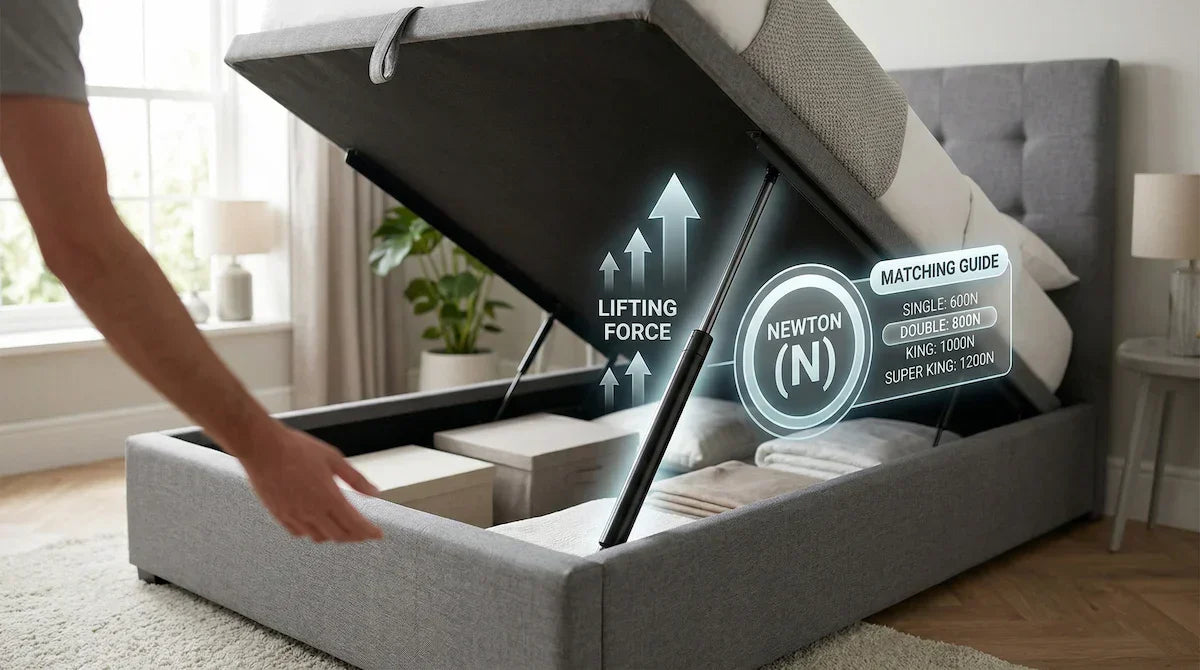
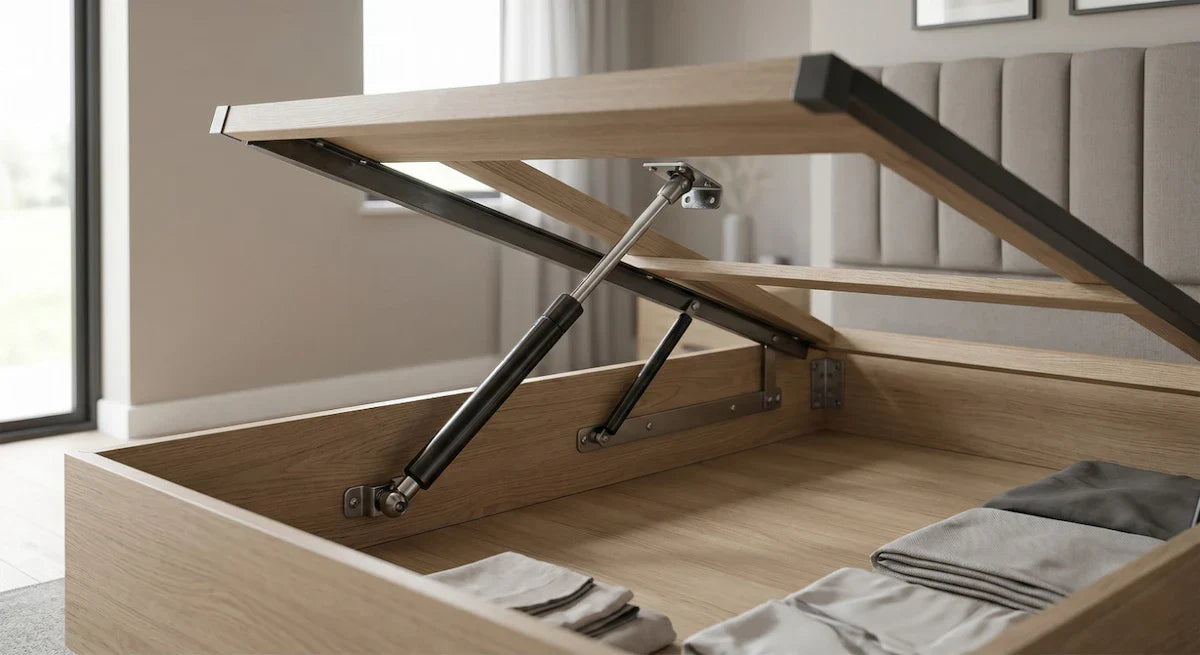
Choosing the wrong gas strut is one of the most common mistakes in any lid-lift project. Too weak and your lid won't stay up; too strong and it'll slam open or put stress on the hinges. Our free gas strut calculator removes the guesswork entirely — but you'll get the best results if you understand what goes into it.
This guide walks you through everything: what measurements to take, how to use the calculator step by step, and how to make sense of the Newton value it gives you.
Ready to find your size? Jump straight to the calculator and come back here if you need help interpreting the results.
Open the Gas Strut Calculator →Why You Can't Just Guess the Force Rating
Gas struts are rated in Newtons (N) — the unit of force they exert at full extension. Unlike a simple spring, a gas strut's force needs to be matched to your specific lid: its weight, its size, where the strut is mounted, and the angle it reaches when open.
A strut rated too low will let the lid drift closed. Too high, and it may prevent the lid closing without effort, or worse, apply uneven force that damages cabinetry or vehicle bodywork over time. The calculator accounts for all of these variables and gives you a recommended Newton rating matched to your exact setup.

What to Measure Before You Start
Have these figures ready before opening the calculator. A few minutes with a tape measure now will save you returning a wrong-sized strut later.
- Lid weight — Weigh the lid if possible, or estimate using material and dimensions. For timber lids, a rough guide is 5–8 kg per m² for 18mm MDF or chipboard.
- Lid length and width — The full dimensions of the panel you're lifting.
- Opening angle — How far the lid needs to open. 90° is standard for most applications; ottoman beds typically need 70–80°.
- Mounting positions — Where the strut will attach on the lid (top bracket) and on the carcass or frame (bottom bracket). These affect mechanical advantage and therefore the force required.
- Number of struts — Most lids use two struts (one on each side). The calculator will give you a per-strut figure.
Step-by-Step: Using the Calculator
-
Enter lid weight
Input the total weight of your lid in kilograms. If you're using two struts, the calculator will divide the load accordingly — enter the full lid weight, not half of it. -
Enter lid dimensions
Input the length and width of the lid panel. This helps the calculator determine the centre of gravity and calculate the torque the struts need to overcome. -
Set the opening angle
Enter the angle in degrees that the lid needs to reach at full extension. Most storage lids open to 90°. Ottoman bed lids typically stop at 70–80° for safety and clearance. -
Enter mounting distances
These are the distances from the hinge to where each end of the strut attaches. The further from the hinge the brackets are placed, the less force is required — so mounting position has a significant effect on the N rating. -
Review the recommended N rating
The calculator will output a recommended Newton value and suggest a stroke length range. Match this to our universal gas strut range to find your size.
How to Interpret the Result
The Newton figure the calculator returns is the recommended force per strut. Here's how to read it:
- 100N–300N — Light lids such as kitchen cabinet doors, small storage hatches, or narrow ottoman lids.
- 400N–600N — Medium-weight lids: full-size ottoman beds, workshop storage cabinets, or boat hatches.
- 700N–1000N — Heavy lids including hardwood cabinetry, large storage boxes, or commercial enclosures.
- 1200N–2000N — Industrial applications, heavy machinery covers, or bespoke commercial fabrications.
If your result falls between stock ratings (for example, 350N), round up to the next available size. A slightly stronger strut is safer than one that's borderline weak. The lid will hold open more positively, and the struts will last longer because they're not working at their limit.
Horizontal vs Vertical Lifts: Does the Angle Matter?
Vertical lift (standard)
- Lid opens upward from a horizontal base
- Most common: ottoman beds, storage boxes, chest lids
- Gravity acts directly against the lift — full lid weight must be supported
- Calculator is optimised for this configuration
Horizontal/angled lift
- Lid swings outward rather than straight up
- Common on: car boots, side-opening enclosures, angled panels
- Gravity acts at an angle — effective load on the strut is lower
- Use the angle field in the calculator to account for this
The opening angle field in the calculator is particularly important for non-vertical lifts. A lid that opens to 120° (past horizontal) requires less strut force in the final portion of its travel — so the calculator adjusts accordingly. Always enter the true final opening angle rather than assuming 90°.
Stroke Length: Matching Extension to Your Space
The Newton rating tells you the force; the stroke length tells you how far the strut extends. Stroke length is the distance between the strut's compressed and fully extended positions — not the total body length.
As a general rule, stroke length should be roughly 60% of the lid's longest dimension for most vertical lift applications. The calculator will suggest a stroke range alongside the Newton figure. If space is tight (for example, inside an ottoman frame), choose the shortest stroke within the suggested range and confirm that it fits your compressed and extended clearances before ordering.
Still Not Sure? Here's What to Do
Get help choosing the right strut
If your application is unusual — an angled lid, a very heavy panel, a vehicle-specific fitment, or a custom enclosure — the calculator may flag that additional advice is needed. In that case, get in touch with the dimensions and weight of your lid and we'll recommend the right spec directly.
You can also run the calculator first and share the output with us — that gives us everything we need to confirm or refine the recommendation.