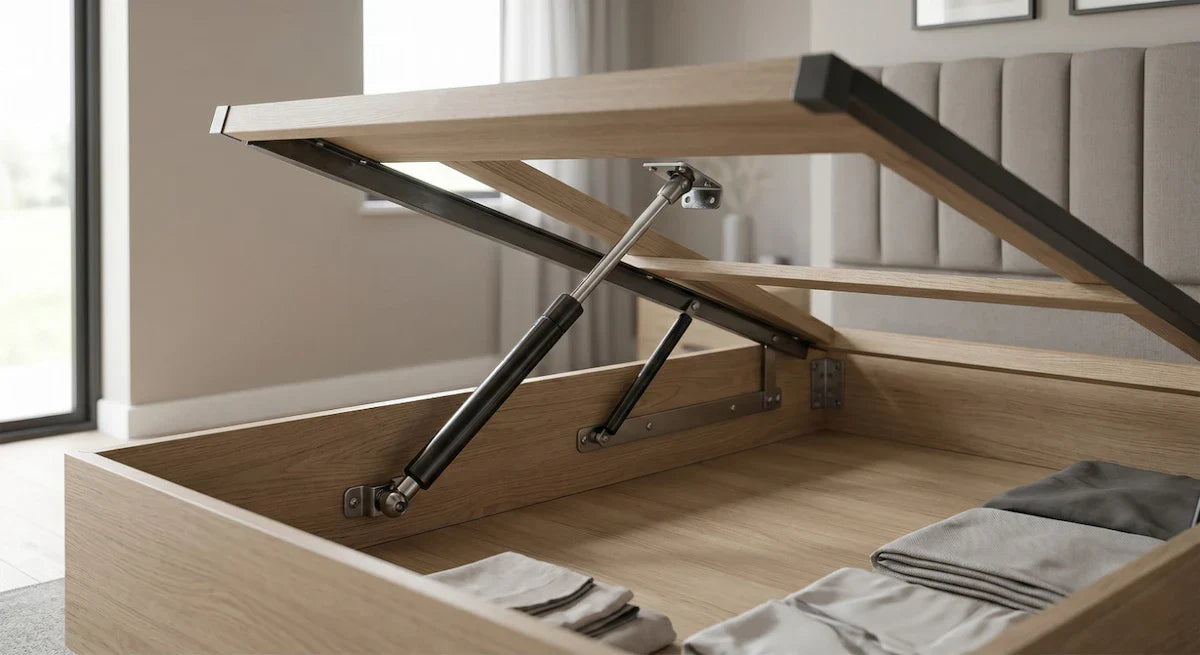

How to Replace Gas Struts on an Ottoman Bed
Replacing the gas struts on an ottoman bed is one of the more satisfying DIY jobs you can do at home — it takes around 30 to 45 minutes, costs a fraction of a new bed, and the difference is immediate. This guide walks you through the full process, from removing the worn struts to testing the finished lift.
Not sure whether your struts actually need replacing? Read our Ottoman Bed Gas Struts Not Working — Diagnosis Guide first, then come back here once you have confirmed the struts are the problem.
What You Will Need
Before you start, gather the following:
- Replacement gas struts — matched to your bed size (see the Newton selector table below)
- Flat-head screwdriver — for releasing the ball-socket clips
- Torx screwdriver or hex key — some bed frames use Torx bolts on the bracket mounts
- A second person — essential for holding the base safely while you work
- A prop or support bar — to hold the base open independently if working alone
You do not need power tools, specialist knowledge, or any modifications to your bed frame. The entire job uses hand tools.
Safety First
An ottoman bed base is heavy — typically 15 to 30 kg depending on size and material. Before you begin:
- Never work under an unsupported base. Always use a prop or have a second person holding the base open. A failing strut can release without warning.
- Remove the mattress first. This reduces weight significantly and gives you better access to the strut mounting points.
- Empty the storage compartment. Loose items can shift and create a trip hazard when the base is lifted.
- Do not compress a new strut by hand. Gas struts are under significant internal pressure — never attempt to shorten one manually or dismantle it.
Step-by-Step: Removing the Old Struts
Step 1 — Remove the mattress and open the bed
Lift the mattress off and set it aside. Open the bed base fully and secure it in position using a prop or ask your helper to hold it steady throughout. The base must remain completely open while you work.
Step 2 — Locate the strut mounting points
You will find one strut on each side of the bed, running diagonally between the bed frame and the lifting base. Each strut has two ends: a body end (the larger cylinder) and a piston end (the thinner rod). Both ends clip onto a ball stud using a socket connector.
Step 3 — Release the piston end first
Insert a flat-head screwdriver into the small notch or tab on the socket clip at the piston end. Lever gently outward — the clip will release and the socket will pop free from the ball stud. Do not force it. If it resists, check for a retaining tab that needs to be depressed before pulling.
Step 4 — Release the body end
Repeat the same process at the body end of the strut. Once both ends are free, the strut will come away completely. Set it aside.
Step 5 — Repeat on the second strut
Move to the opposite side of the bed and repeat Steps 3 and 4. Both struts should now be removed. Take a moment to inspect the ball studs on the frame — if any are bent, corroded, or loose, tighten or replace them before fitting the new struts.
Step-by-Step: Fitting the New Struts
Step 6 — Check the orientation
New struts are not symmetrical. The body (cylinder) end always mounts to the bed frame, and the piston (rod) end mounts to the lifting base. Fitting them the wrong way around will damage the strut and produce poor lift. Check the original struts or the marks left on the ball studs to confirm which end goes where.
Step 7 — Attach the body end first
Press the socket at the body end firmly onto the ball stud on the bed frame. You will hear and feel a distinct click when it seats correctly. Give it a gentle tug to confirm it is locked.
Step 8 — Attach the piston end
Extend the strut slightly if needed and press the piston-end socket onto the ball stud on the lifting base. Again, listen for the click and tug to confirm. The strut should now feel rigid between the two mounting points with no wobble.
Step 9 — Fit the second strut
Repeat Steps 7 and 8 on the opposite side. Both struts must be identical in Newton rating — mismatched struts create uneven lift and will wear the hinge mechanism prematurely.
Testing the Lift
With both struts fitted, remove your prop or ask your helper to release the base gradually. The base should rise smoothly and hold itself open without assistance. Then lower it gently — it should offer light resistance rather than dropping freely.
If the base feels too heavy to lift, the Newton rating may be too low for your mattress weight. If it lifts too sharply or will not stay closed, the rating is too high. Use the Gas Strut Calculator to confirm the correct force for your setup.
Replace the mattress and test the lift a further two or three times with the full weight in place. The struts will settle slightly over the first few cycles — this is normal.
Choosing the Right Newton Rating
Fitting the correct Newton (N) rating is as important as the installation itself. An undersized strut will struggle to lift the base; an oversized one lifts too aggressively and is difficult to close. Match your bed size to the table below.
| Bed size | Newton rating | Typical mattress weight | Shop struts |
|---|---|---|---|
| Single / Small double Up to 90 cm wide | 600 N | Up to 18 kg | From £11.90 View 600 N struts → |
| Double / Queen 135 – 150 cm wide | 800 N | 18 – 25 kg | From £12.90 View 800 N struts → |
| King / Large queen 160 – 180 cm wide | 1000 N | 25 – 33 kg | From £13.90 View 1000 N struts → |
| Super king / XL king 180 cm+ wide | 1200 N | 33 kg+ | From £14.90 View 1200 N struts → |
If you are between sizes or use a particularly heavy mattress, round up to the next rating. Still unsure? The Gas Strut Calculator gives you a precise recommendation based on your exact bed dimensions and mattress weight.
Do You Need a Complete Set?
If your hinge arms are also worn, stiff, or damaged, replacing the struts alone will not fully restore smooth operation. In that case, a complete replacement kit is the better value option.
- Complete Lift Set — struts and mechanism — from £21.90
- Hinge Mechanism Only — £18.90 (if struts are still serviceable)
Browse the full range at the Autorce Ottoman Bed Gas Struts collection.
Frequently Asked Questions
Q: How long does it take to replace ottoman bed gas struts?
A: Most people complete both sides in 30 to 45 minutes. The job is quicker with two people — one to hold the base, one to work on the clips.
Q: Do I need to remove the bed frame from the wall first?
A: Not usually. You only need access to the sides of the bed where the struts are mounted. If your bed is pushed tightly against a wall on one side, pull it out slightly before you begin.
Q: Can I reuse the existing ball studs and brackets?
A: Yes, as long as they are undamaged. Inspect them before fitting the new struts — a loose or corroded stud will cause the socket to pop free during use.
Q: My new struts are very stiff to close — is that normal?
A: New struts can feel firmer than expected for the first few cycles. If the bed is genuinely difficult to close after five or six uses, the Newton rating may be too high for your setup. Check against the table above or use the Gas Strut Calculator.
Q: The socket will not click onto the ball stud — what should I do?
A: Check that the ball stud diameter matches the socket on the new strut. Most UK ottoman beds use an 8 mm or 10 mm ball stud. If the socket is visibly too large or too small, contact Autorce before proceeding.
Q: Can I fit gas struts from a different Newton rating on each side?
A: No. Always fit matching struts on both sides. Mismatched ratings cause the base to twist under load, which damages both the struts and the hinge mechanism.
Last updated: April 2026