
What Is a Car Boot Strut?
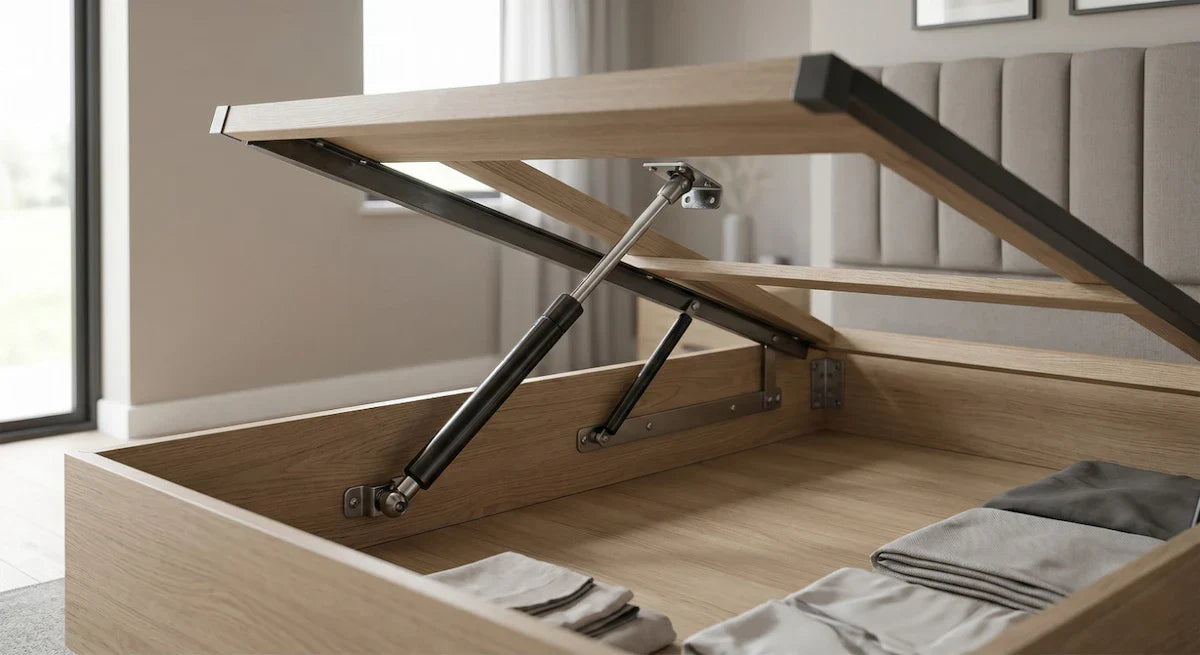
A boot strut — also called a boot gas strut or tailgate strut — is the spring-loaded arm that holds your car's boot lid open. Press it down and it compresses; let it go and it pushes back, keeping the boot raised while you load and unload. Most modern hatchbacks, estates, and SUVs use two struts, one on each side of the tailgate.
The mechanism is straightforward: a sealed cylinder filled with compressed nitrogen pushes a piston rod outward. Over time, the internal seals degrade and gas pressure escapes — at which point the strut can no longer do its job.
Signs Your Boot Struts Need Replacing
Boot strut failure is gradual. You'll usually notice the symptoms weeks before the strut stops working entirely.
- The boot won't stay open — the clearest sign. If you have to prop the boot open with your arm or an object, the struts have lost pressure.
- The boot drops slowly rather than falling immediately — early-stage pressure loss. The strut is still providing some resistance but not enough to hold the weight.
- The boot opens sluggishly — healthy struts should assist the lift noticeably. If you're doing all the work, they're worn.
- Oily residue on the strut body — a sign the internal seal has failed and the gas has leaked out along with lubricating fluid.
- The boot drops unevenly or tilts to one side — indicates one strut has failed faster than the other. Replace both.
- Visible corrosion or a bent shaft — physical damage that prevents smooth operation and should be addressed promptly.
Worth noting: boot struts on high-mileage vehicles used for heavy loading tend to wear faster. If your boot is regularly loaded with tools, shopping, or equipment, inspect the struts annually.
How to Find the Right Boot Strut for Your Car
Fitting the wrong strut is the most common mistake. Force rating, extended length, and end fittings must all match your vehicle — otherwise the boot won't open properly or the strut won't seat correctly.
1. Use Your Vehicle Make, Model, and Year
The most reliable method. Vehicle-specific struts are already matched to the correct Newton rating and length for your boot. Use your registration number to confirm the exact model variant before ordering.
2. Cross-Reference the OEM Part Number
The original strut will have a part number stamped on the barrel or on a label near the end fitting. Searching this number gives you an exact match. Common examples include 1336230 on Ford Focus MK2 struts and 5N0827550 on VW Tiguan struts.
3. Measure If the Number Is Gone
Measure the strut fully extended — this is the extended length in millimetres. Also note the Newton (N) rating on the barrel, which tells you the force the strut exerts. Both figures must match your replacement.
4. Check the End Fittings
Most UK passenger car boot struts use a 10mm ball socket on both ends. Some SUVs and commercial vehicles use different fitting types — confirm before ordering if you're unsure.
How to Replace Boot Struts — Step by Step
This is a straightforward DIY job. No ramps, no specialist tools — just a trim removal tool or flat-head screwdriver and a safe way to support the boot while you work.
What you'll need: flat-head screwdriver or trim clip tool, assistant or prop rod, new struts.
- Open the boot fully and support it securely. Ask someone to hold it, or use a prop. Never work under an unsupported boot lid.
- Locate the strut end fittings. Each strut has two ends — upper (attached to the boot lid) and lower (attached to the body). Both are held by a clip on a ball stud.
- Release the lower end first. Slide a flat-head screwdriver or trim tool behind the retaining clip and lever it free. The strut end pops off the ball stud.
- Release the upper end. Support the strut as you do this — it will be under slight tension. Remove the strut completely.
- Fit the new strut. Press the upper socket onto the ball stud first until it clicks. Then press the lower end into place. Both ends should click firmly.
- Repeat on the other side. Always replace both struts together — mismatched pressure causes uneven lift and stresses the tailgate hinges.
- Test the boot. Lower it to around 30cm from closed and release. It should hold open without drifting. If it sags, recheck that both ends are fully seated.
New struts may feel slightly stiffer than expected for the first few cycles. This is normal — the seals are bedding in.
Boot Struts for Popular UK Vehicles
Below are vehicle-specific boot struts for some of the most common models we see searched. All are supplied as matched pairs and ready to fit.
| Vehicle | Spec | Price |
|---|---|---|
| Ford Focus MK2 (2004–2012) | 420N · 585mm | £17.90 |
| Ford C-Max MK2 (2010–onwards) | 580N · 705mm | £18.75 |
| VW Tiguan (2007–2018) | 475N · 520mm | £17.90 |
| Land Rover Discovery MK3/MK4 (2004–2017) | 480N · 480mm | £17.90 |
Don't see your vehicle? Browse the full range — we stock boot struts for a wide range of UK cars, estates, and SUVs.
Browse All Boot Struts →Frequently Asked Questions
Are boot struts and hydraulic boot arms the same thing?
Yes — they refer to the same component. Boot struts use compressed nitrogen rather than hydraulic oil, but the term "hydraulic arm" is widely used in everyday language. You may also see them called tailgate struts, boot gas struts, or rear hatch struts depending on the vehicle type.
Can I replace just one boot strut, or do I need to replace both?
Always replace both at the same time. Struts degrade at a similar rate, so if one has failed, the other is close behind. Fitting a single new strut alongside a worn one causes uneven lift, puts strain on the tailgate hinges, and usually means you'll be replacing the second strut within months anyway.
How do I know what Newton rating I need?
The Newton (N) rating is printed on the barrel of your existing strut. It indicates the force the strut exerts — too low and the boot won't stay open, too high and it'll fly up or stress the hinges. If the rating is no longer legible, look up your vehicle's OEM part number or use our vehicle-specific listings to find the correct spec.
My boot opens but won't stay up — is it definitely the struts?
In almost all cases, yes. A boot that opens but gradually drops is the classic sign of pressure loss in the struts. The only other causes would be a damaged tailgate hinge or a boot lid that is significantly heavier than standard (for example, a spare tyre mounted externally), which would require a higher Newton rating than the original fitment.
How long do boot struts typically last?
Most boot struts last between 8 and 12 years under normal use. Vehicles that are used for heavy loading, parked outdoors in cold climates, or have high annual mileage tend to see faster wear. There is no fixed replacement interval — replace on condition when symptoms appear.
Can I fit boot struts myself without a garage?
Yes — it is one of the more straightforward DIY jobs on a modern car. You need a flat-head screwdriver or trim clip tool to release the end fittings, and a safe way to support the boot lid while you work. The job typically takes 20–30 minutes per side and requires no ramps or specialist equipment.