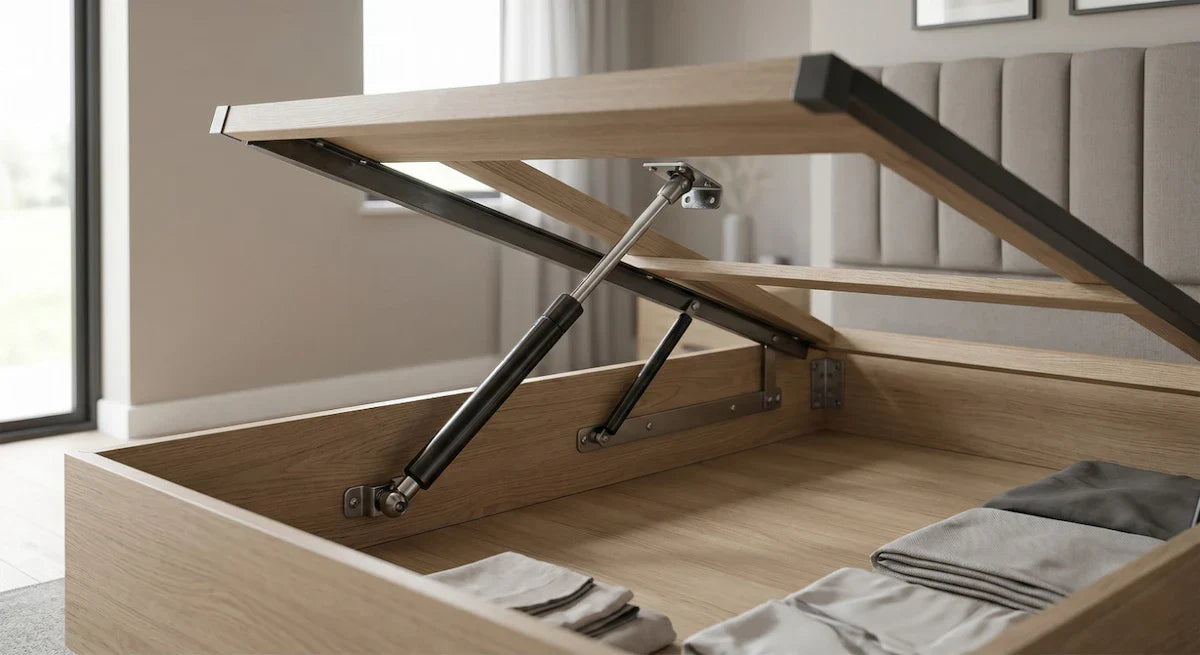

Why Use a Gas Strut on a Kitchen Cabinet Door?
Traditional kitchen cabinet hinges do one job: they let the door open and close. A gas strut does something more — it controls how the door moves. Fitted to overhead cupboards and wall-mounted units, a gas strut holds the door open at any angle, takes the weight of heavier doors, and returns the door to closed smoothly without slamming.
For overhead cabinets in particular, this matters. A door that stays open frees up both hands while you reach inside. A door that closes gently protects the cabinet frame and reduces noise. And for anyone fitting a lift-up or flap-up door rather than a standard side-swing hinge, gas struts are the mechanism that makes it work.
Choosing the Right Newton Rating for Your Cabinet
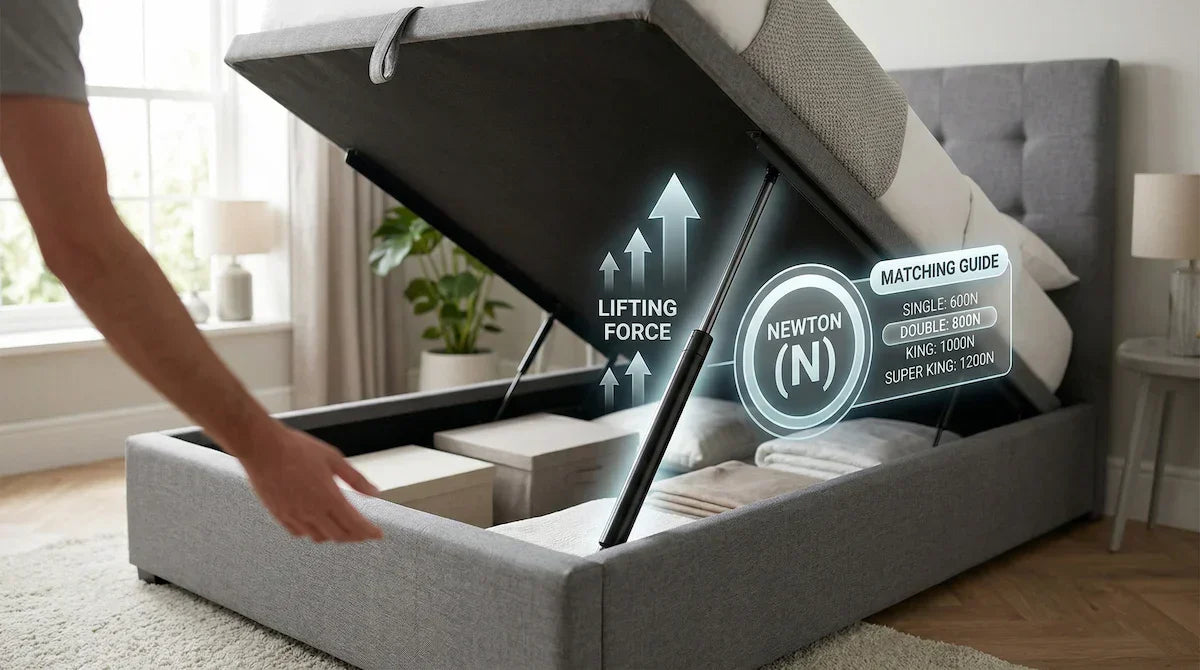
The Newton (N) rating tells you how much force the strut exerts. For kitchen cabinets, matching the Newton rating to the weight and size of your door is the most important decision you'll make. Too low and the strut won't hold the door open; too high and it will fly up or be difficult to close.
As a general guide:
| Door Weight | Typical Application | Recommended Range |
|---|---|---|
| Up to 2 kg | Small wall cupboard, light MDF door | 100N |
| 2–4 kg | Standard overhead cabinet, medium door | 200N |
| 4–6 kg | Large overhead unit, solid wood or glazed door | 300N |
If you're fitting two struts (one on each side of the door), divide the total force needed by two to get the rating per strut. For example, a 4 kg door needing 200N total force requires two 100N struts.
Not sure of your door weight? Lift it off its hinges and use bathroom scales. It takes 30 seconds and makes the Newton calculation straightforward.
Soft Close vs Standard Gas Struts — What's the Difference?
Standard gas struts hold a door open and provide a controlled, assisted return to closed. They work well for most kitchen cabinet applications where the door closes under its own weight with the strut providing resistance.
Soft close gas struts add a damping mechanism at the end of the closing travel — the strut slows the door in the final 10–15mm before it meets the frame. This eliminates the impact sound and reduces wear on hinges and cabinet frames over time.
For kitchen use, soft close is worth choosing if:
- The cabinet is in a frequently used area and noise matters
- The door is heavier and builds up speed on closing
- The cabinet frame is solid wood or a material sensitive to repeated impact
For lighter doors on occasional-use cabinets, a standard strut performs perfectly well and costs less.
Fitting Notes — What to Check Before You Start
Kitchen cabinet gas struts use smaller end fittings than automotive struts. Most furniture applications use an 8mm ball stud rather than the 10mm standard found on car bonnets and boots. Check your existing fittings or the cabinet manufacturer's specification before ordering.
Key measurements to take before fitting:
- Extended length — measure from centre of end fitting to centre of end fitting with the strut fully extended
- Compressed length — the same measurement with the strut fully compressed
- Stroke length — the difference between the two; this determines how far the door travels
- Mounting positions — where the strut attaches on the door and the cabinet body affects the angle and force applied
If you're replacing existing struts, measure the old ones rather than calculating from scratch. Extended length and Newton rating from the original strut give you everything you need.
Common Mistakes to Avoid
- Choosing by length alone. Two struts can share the same extended length but have very different Newton ratings. Always confirm both measurements.
- Fitting a single strut on a wide door. Doors wider than around 500mm typically need two struts to distribute the force evenly and prevent the door from twisting on its hinges.
- Mounting too close to the hinge. The further the strut mounting point is from the hinge pivot, the less force is needed to hold the door. Moving the bracket even 20–30mm can make a meaningful difference.
- Ignoring the shaft orientation. The piston rod (narrower end) should face downward on vertical applications. Fitting it upside down causes oil migration inside the strut and reduces its working life.
- Over-tightening the end fittings. Ball socket end fittings should click firmly into place — they don't need to be forced. Over-tightening can crack the socket or distort the ball stud.
Autorce stocks universal gas struts from 100N to 2000N, suitable for kitchen cabinets, overhead cupboards, and furniture applications. All struts include ball socket end fittings as standard.
Browse Gas Struts by Force Rating →Frequently Asked Questions
How do I calculate the Newton rating I need for my cabinet door?
Weigh the door (bathroom scales work well), then use the general guide: up to 2 kg needs 100N, 2–4 kg needs 200N, and 4–6 kg needs 300N. If fitting two struts, divide the total Newton figure by two to get the rating per strut. The mounting position also affects the force needed — the further from the hinge, the less force is required.
Can I use automotive gas struts on kitchen cabinets?
Technically yes, but it is rarely practical. Automotive struts are designed for much heavier loads and use 10mm ball studs as standard. Most kitchen cabinets use 8mm fittings, and the force ratings of automotive struts are typically far too high for furniture applications. Universal furniture-rated gas struts in the 100N–300N range are the correct choice for kitchen cabinets.
Do I need one strut or two for my cabinet door?
For doors up to around 500mm wide, a single centrally mounted strut is usually sufficient. For wider doors, two struts — one on each side — distribute the force more evenly and prevent the door from twisting on its hinges. If in doubt, two struts at a lower Newton rating each is preferable to one strut at a higher rating.
What is the difference between soft close and standard gas struts?
Standard gas struts hold the door open and provide controlled resistance as it closes. Soft close struts add a damping mechanism that slows the door in the final few millimetres of travel, preventing it from slamming shut. For kitchen cabinets used frequently or with heavier doors, soft close is worth the small additional cost.
Which way up should a gas strut be fitted?
The piston rod — the narrower, extending end — should face downward on vertical applications such as cabinet doors. Fitting a strut inverted causes the internal oil to migrate away from the seals over time, reducing the strut's working life. Most struts have a directional marking; if not, the rule is rod-down.
Can I fit kitchen cabinet gas struts myself?
Yes — it is a straightforward DIY task. You need a drill, the correct drill bit for your bracket fixings, and a pencil for marking positions. The key is taking accurate measurements before drilling: extended length, stroke, and bracket position relative to the hinge. Most installations take under an hour per door.