Gas Strut Brackets & Fittings Guide — Ball Joint, Eyelet & Mounting
A gas strut is only as reliable as the fittings holding it in place. Choose the wrong end fitting or bracket, and the strut will either pull free under load, wear unevenly, or fail to pivot correctly — none of which you want on a heavy lid or cabinet door. This guide explains the main fitting types, what the thread sizes mean, and how to choose the right combination for your application.
Why the Right Fitting Matters
Gas struts generate significant force — anywhere from 100 N to 2000 N depending on the application. That force is transferred entirely through the end fittings into the mounting surface. A fitting that is the wrong size, wrong thread, or wrong type for the pivot angle will concentrate stress at a single point and fail prematurely. Getting the fitting right from the start means the strut performs as rated for its full service life.
Fitting Types Explained
Ball Joint Fittings
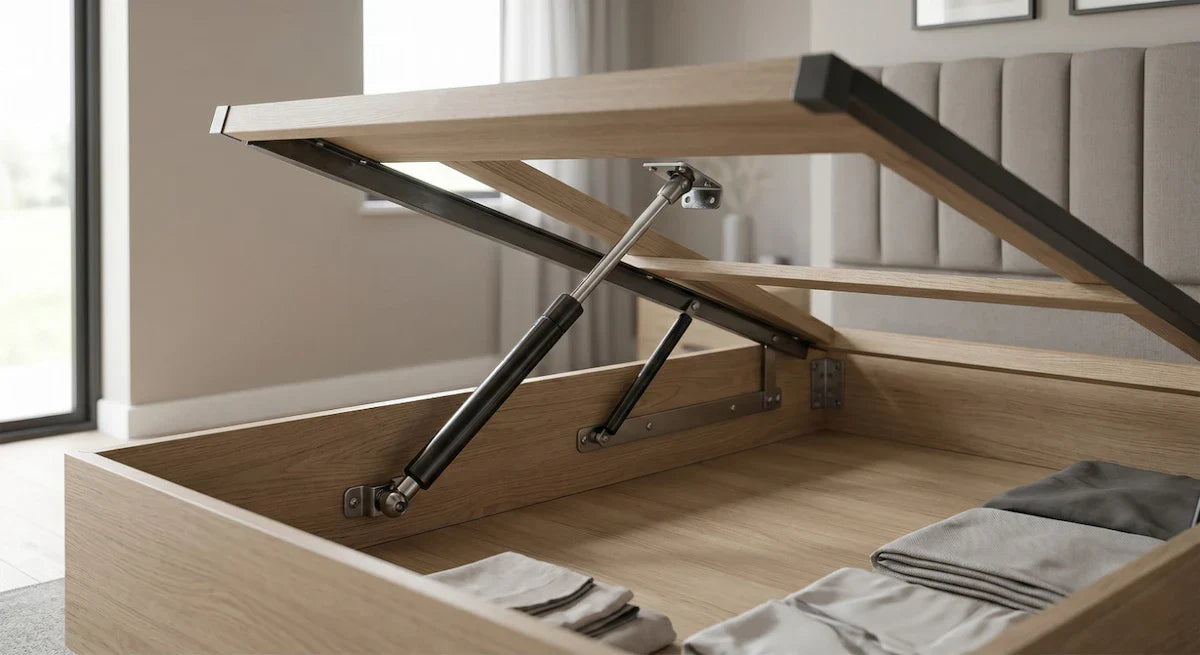
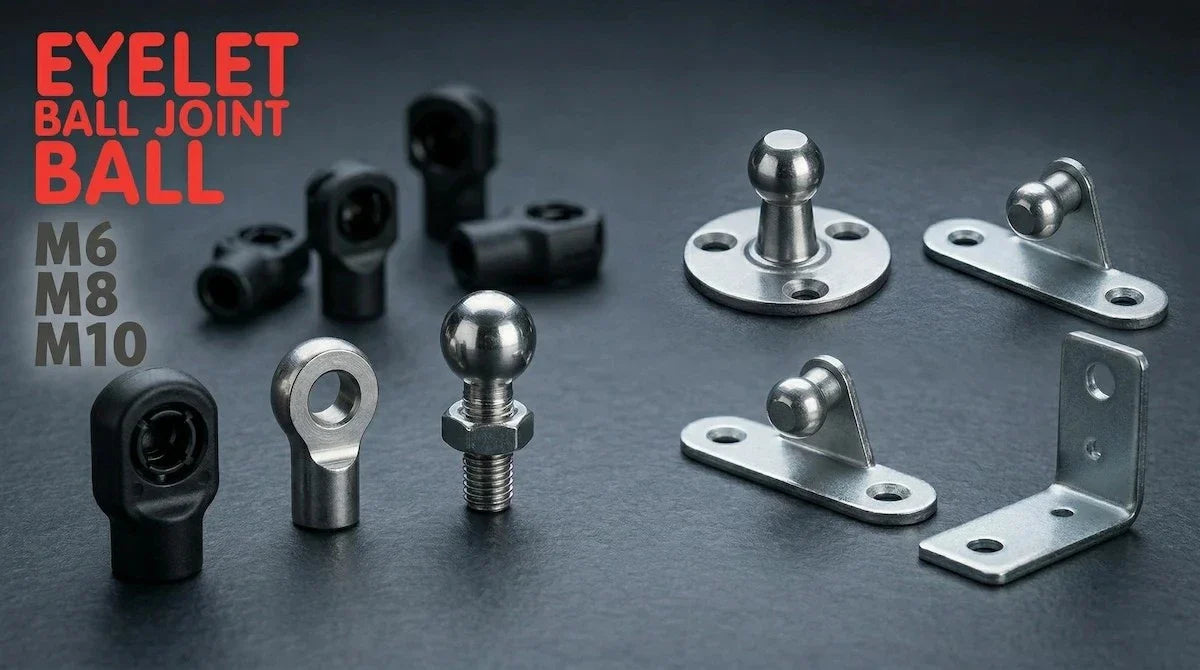
The most common fitting type for general gas strut applications. A ball joint consists of a metal ball housed in a plastic or metal socket. The socket clips onto the ball and allows the strut to pivot freely in multiple directions — typically up to 25–30 degrees off-axis. This makes ball joints the correct choice wherever the strut does not travel in a perfectly straight line during operation, which covers most hinged lids, cabinet doors, and bed lift mechanisms.
Autorce stocks Steel Ball Heads (£8.99) and Plastic Ball Heads in M6, M8, and M10 (£7.99) to suit different load requirements and environments.
Eyelet Fittings
An eyelet fitting is a fixed loop that bolts directly through a mounting point using a pin or bolt. Unlike ball joints, eyelets do not allow multi-directional pivot — the strut can only rotate in a single plane. Eyelets are typically used in applications where the strut travels in a consistent arc and the mounting geometry is fixed, such as certain industrial panels or machinery guards. Eyelet Heads are available at £8.99.
Ball Joint Head Fittings
A ball joint head combines the pivot freedom of a ball joint with a cleaner, more compact profile. These are used where space around the mounting point is limited or where a neater finish is required. Ball Joint Heads are available at £8.99.
Thread Sizes — M6, M8, M10
The M number refers to the diameter of the thread on the strut's piston rod end, measured in millimetres. Getting this right is essential — an M8 fitting will not seat securely on an M6 rod, and forcing it risks stripping the thread.
- M6 (6 mm thread) — used on lighter-duty struts, typically up to around 500 N. Common on furniture, smaller cabinet lids, and light automotive applications. End Fittings M6 from £3.49.
- M8 (8 mm thread) — the most widely used size for mid-range struts (500 N–1000 N). Covers the majority of ottoman bed struts, tool box lids, and workshop cabinet applications.
- M10 (10 mm thread) — heavy-duty applications, typically 1000 N and above. Used on larger industrial lids, heavy automotive bonnets, and high-load storage.
If you are replacing an existing fitting, remove the old one and measure the thread diameter directly with a calliper or thread gauge before ordering. Do not estimate by eye.
Bracket Types
L-Type Ball Brackets
An L-shaped bracket that mounts flush against a flat surface — typically a panel edge or frame rail — and presents a ball stud at 90 degrees to the mounting face. This is the standard bracket for most cabinet and furniture installations where the strut needs to be offset from the surface. Available in M6 (2x £6.90 / 4x £10.90) and M8 (2x £6.90 / 4x £10.90).
Heavy Duty Ball Joint Brackets
A reinforced bracket designed for higher-load applications where a standard L-type bracket would flex or fatigue. Suitable for large lids, heavy panels, or installations subject to frequent cycling. The Heavy Duty Ball Joint Brackets (2 pack, £7.99) use thicker steel construction and a larger ball stud for improved load distribution.
How to Choose the Right Combination
Work through these three questions in order:
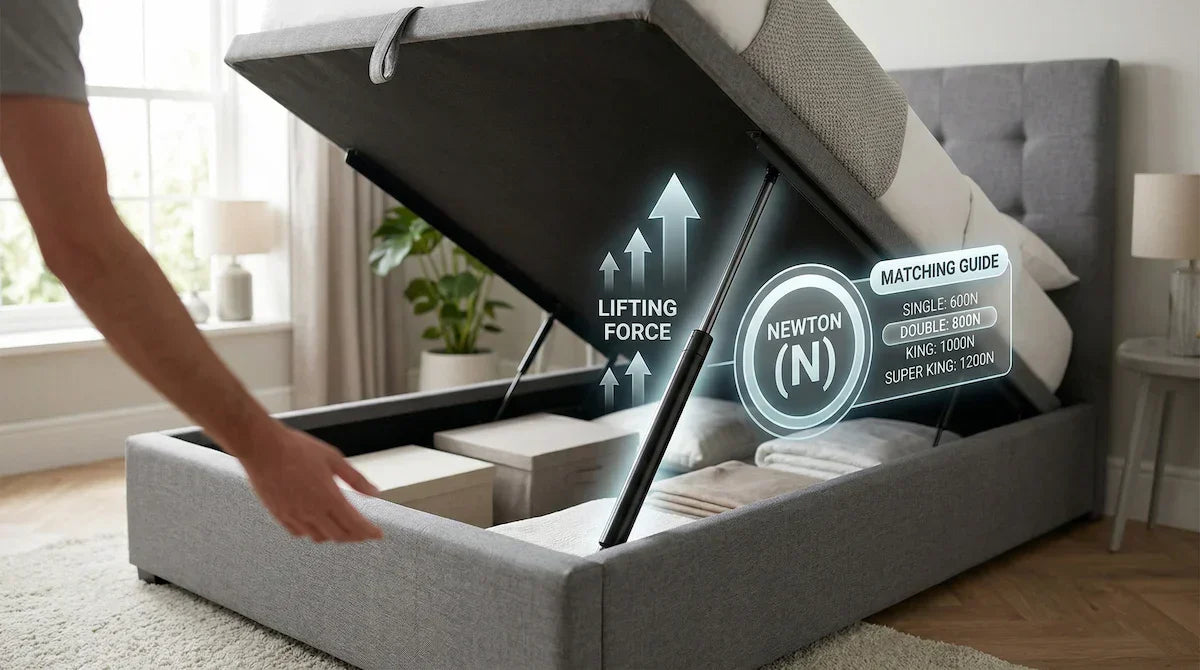
1. What is the load? Weigh the lid, door, or panel you are lifting. This determines the Newton rating of the strut, which in turn determines the thread size you need. Light loads (up to ~15 kg) — M6. Mid loads (15–35 kg) — M8. Heavy loads (35 kg+) — M10. Use the Gas Strut Calculator to confirm the correct Newton rating before selecting fittings.
2. Does the strut need to pivot in more than one plane? If the lid or panel swings through an arc that is not perfectly straight — which describes most hinged applications — you need a ball joint fitting. If the movement is strictly single-plane (rare in practice), an eyelet will work.
3. What is the mounting surface? A flat panel edge takes an L-type bracket. A thicker frame or rail may suit a direct-mount ball stud. If the application is subject to high loads or frequent use, step up to the heavy duty bracket regardless of strut size.
Frequently Asked Questions
Q: Can I mix fitting types on the same strut — for example, a ball joint at one end and an eyelet at the other?
A: Yes, this is common. The body end and the piston end can use different fitting types depending on the geometry of each mounting point.
Q: My existing brackets are fine — can I just replace the end fittings on the strut?
A: In most cases, yes. As long as the thread size matches and the fitting type suits the pivot angle, you can replace end fittings independently of the brackets.
Q: How do I know if my current fittings are M6, M8, or M10?
A: Remove one fitting and measure the outer diameter of the thread with a calliper. M6 = 6 mm, M8 = 8 mm, M10 = 10 mm. If you do not have a calliper, a thread gauge is inexpensive and available from most hardware suppliers.
Q: Do plastic ball heads perform as well as steel ones?
A: For most furniture and storage applications, yes. Plastic ball heads are lighter, resist corrosion, and are quieter in operation. Steel ball heads are the better choice for high-load, high-cycle, or outdoor applications where long-term durability under stress matters more than weight.
Last updated: April 2026